Impact
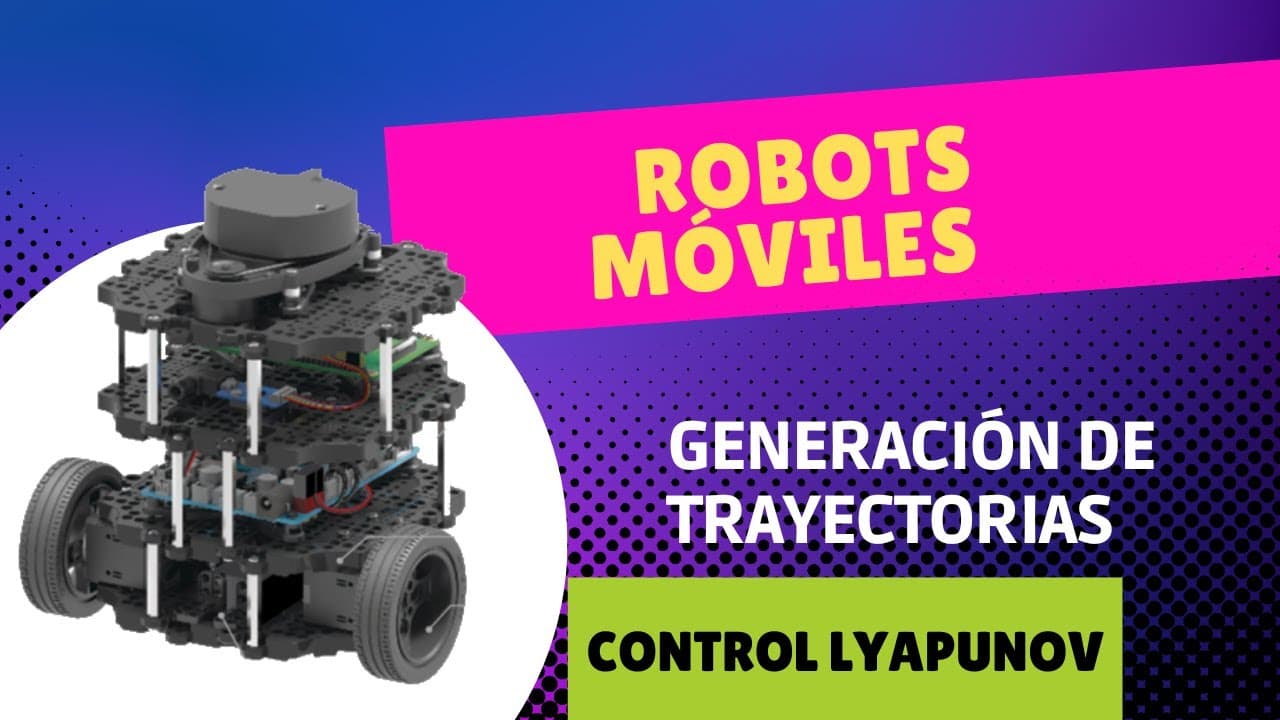
- Successfully implemented real-time trajectory control for differential robots
- Integrated with physical robot hardware
- Developed simulation environment for testing and validation
Trajectory Control for Differential Robots with Gazebo Simulation and Lyapunov Control
Overview 🚀
I developed a complete trajectory control system for differential mobile robots that enables precise control over position and orientation. This system opens up numerous possibilities, from automated configurations to practical applications in robotized distribution warehouses and advanced logistics systems.
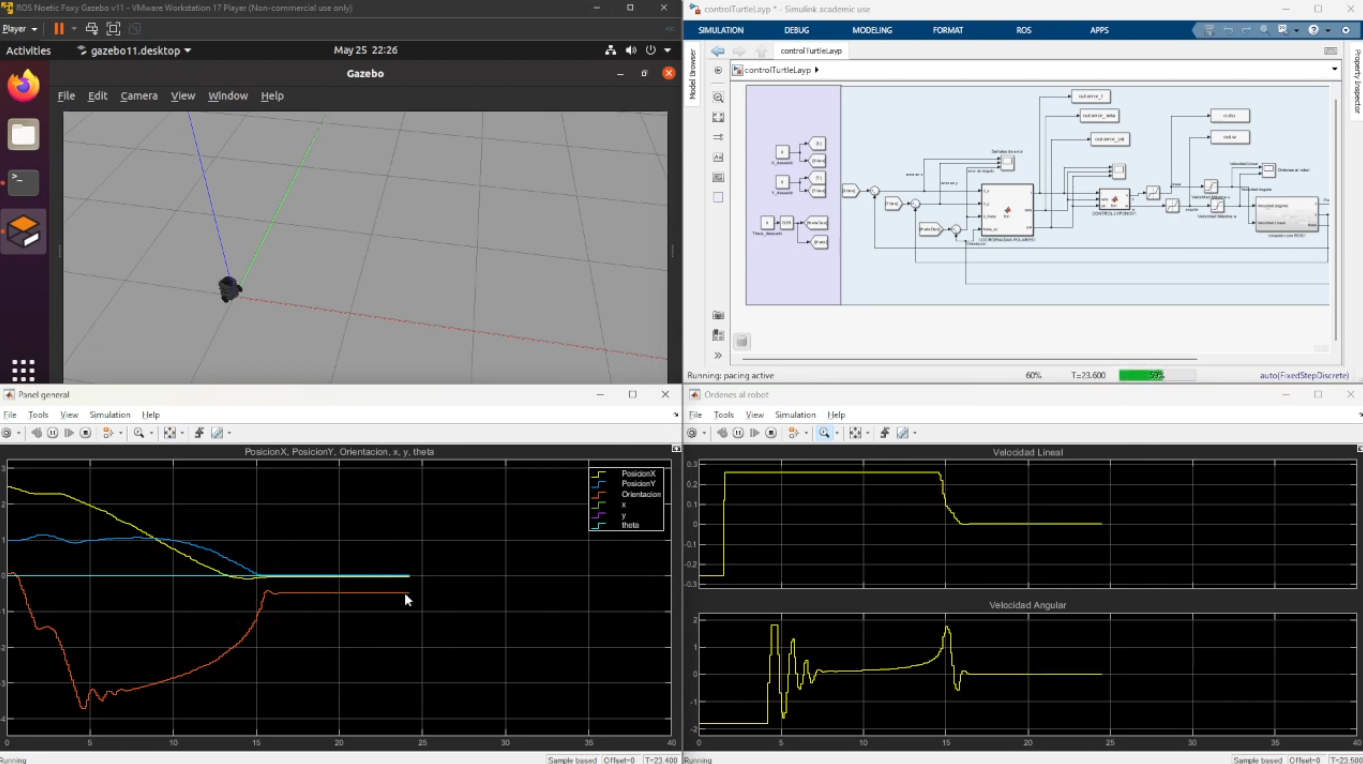
Communication with the robot is achieved through ROS, using Simulink to implement the controller and connect to the Gazebo simulator hosted in a virtual machine. This environment allows for simulation tests that faithfully replicate behavior under real-world conditions, thus validating the system's robustness for direct application to physical robots.
Technical Details 💡
Controller Design
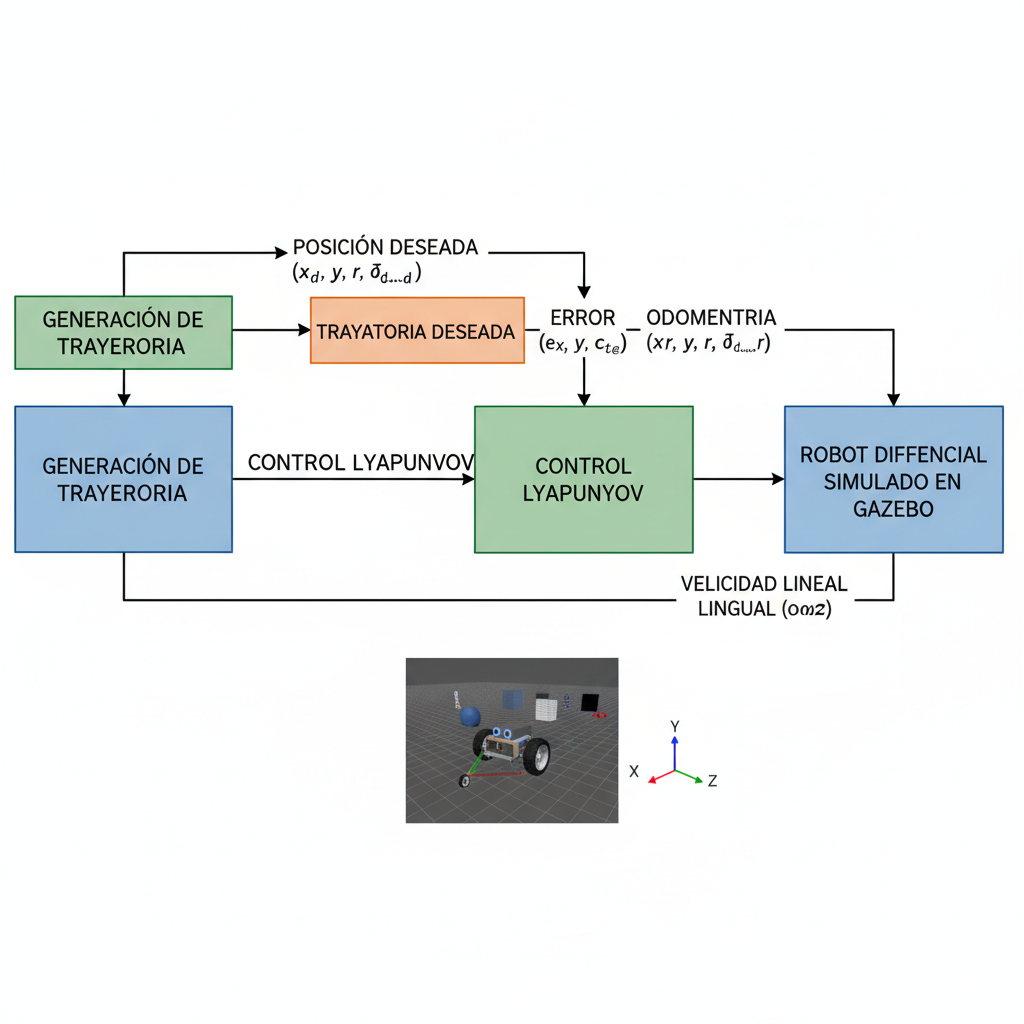
The project implements a trajectory generator capable of guiding a differential robot in real-time towards a desired position and orientation. The system:
- Takes robot odometry values as input
- Performs internal calculations using Lyapunov control theory
- Generates linear and angular velocity signals to control robot movement
- Ensures stability even with system perturbations and uncertainties
Implementation Stack
- ROS: Main communication framework for robot interaction
- Simulink: Implementation of the controller logic
- Gazebo: 3D simulation environment hosted in a virtual machine
- Python: Supporting scripts and ROS node implementations
Control Approach
The Lyapunov-based control approach was chosen for its:
- Solid mathematical framework
- Flexibility for different robot types
- Guaranteed trajectory stability
- Robustness against disturbances
Key Features ⚡
- Real-time Control: Dynamic adjustment of robot position and course correction
- Complex Maneuvers: Handles reverse turns and angular movements
- Dead Zone Management: Defines tolerance zones to avoid unnecessary movements near target points
- Simulation Environment: Faithful replication of real-world conditions for testing
- Physical Robot Integration: Successfully tested and implemented on real hardware
Technical Challenges 🔧
The project presented two main technical challenges:
-
Real Robot Integration:
- Establishing reliable communication between the control system and physical robot
- Ensuring real-time performance with minimal latency
- Calibrating control parameters for real-world conditions
-
Matlab-ROS Communication:
- Setting up robust communication between Matlab/Simulink and ROS
- Managing data synchronization between different systems
- Optimizing control loop timing
Results and Impact 🎯
The implemented system successfully demonstrates:
- Precise trajectory following capabilities
- Robust performance in both simulated and real environments
- Practical applicability for industrial and service robotics
- Flexible architecture that can be adapted to different robot configurations
Demonstration
Check out the project in action in this video demonstration showing the robot following various trajectories and responding to control inputs.
Future Improvements 🔄
Potential enhancements for the system include:
- Implementation of obstacle avoidance capabilities
- Integration with path planning algorithms
- Extension to other robot kinematics models
- Development of a more user-friendly interface for trajectory definition
Resources 📚
Gallery
Videos
Demo video
Links
Stack
Tags
Last updated: 2025-09-12