Pre-sales agent – AI operating system for pre-sales and pilots
Author · Engineer · Architect
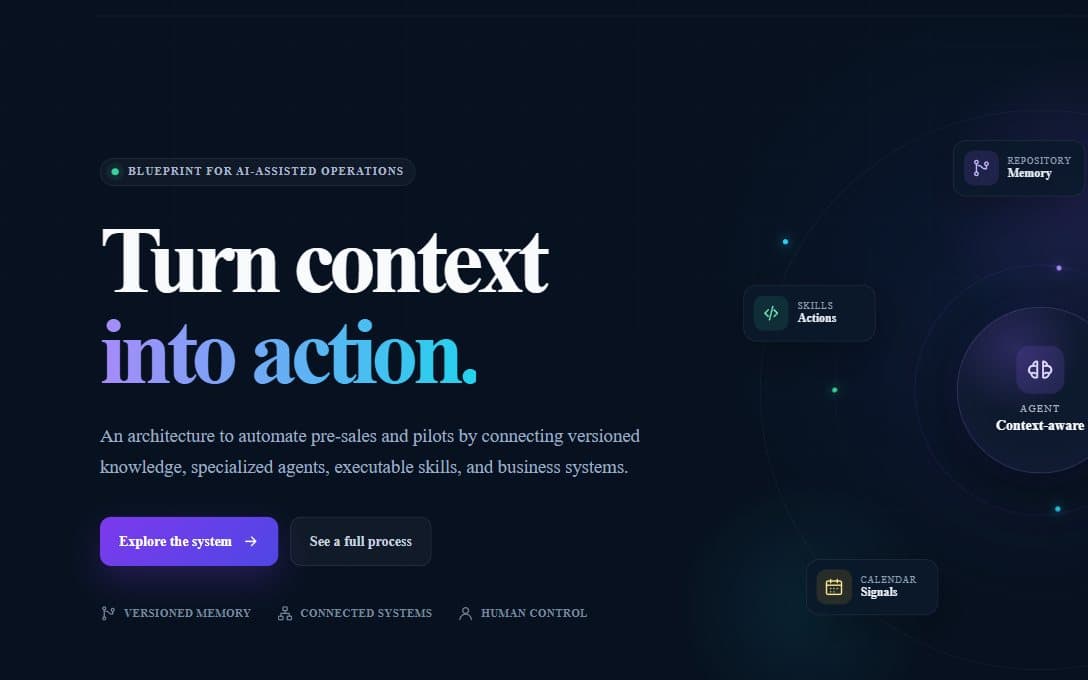
A reusable architecture that turns processes, knowledge, and tools into traceable pre-sales and pilot operations assisted by AI agents, with a human gate before any write.
Impact
- Public bilingual walkthrough of an agent-assisted pre-sales and pilot-operations loop.
- Versioned knowledge, specialized agents, executable skills, and business systems in one architecture.
- Human approval before any write: the agent prepares, a person confirms, then the agent executes and records.
Overview
This is the public write-up of an AI operating system for pre-sales and pilots: a reusable architecture that turns processes, knowledge, and tools into traceable operations assisted by AI agents.
The specialized page — the intended visitor destination — is presalesagent.unmecaniko.com. This file is the public knowledge-base entry for the same work: what it is, what I built, and what a recruiter or another agent can cite without opening the walkthrough.
I run this architecture as Solutions Engineer at Truora, on pre-sales and pilots. The walkthrough is anonymized on purpose: it does not name customers, accounts, IDs, or vendors. That condition is part of the design, not an omission.
The page is bilingual. /es/ is Spanish, /en/ is English; the root follows Accept-Language.
My Contribution
I designed the architecture and the public walkthrough.
- Structured the knowledge the agent is allowed to use: declarative (what we know), operational (how we act), and live context (what is happening), versioned in Git.
- Turned recurring pre-sales and pilot procedures into skills: when to fire, which tools are allowed, how to verify, and what must not happen without confirmation.
- Connected the loop to business systems — CRM, calendar, meeting notes, product APIs — so a request can become a ticket, a session, and a close without recapturing everything by hand.
- Kept a human gate before writes. Tickets, external notes, proposals, and high-impact changes go through a preview. Secrets stay in the environment, never in the repository.
On the CRM side, I use HubSpot for ticket follow-up and built an automation there for that flow. That is public; the rest of the vendor list is not.
Process
A generic agent can draft text. An agent with rules, memory, tools, and procedures can operate consistently. The walkthrough starts from that split.
The pre-sales chain on the public page is six steps:
- Structured request — interpret the commercial need, separate facts from assumptions, detect missing information.
- Triage and verification — confirm there is a use case, a product, and a real technical need; look for duplicates before creating anything.
- Draft for approval — propose process type, pipeline, description, owners, and fields; a person confirms before anything is written.
- CRM + repository — create the ticket and, in the same flow, open or update the versioned context.
- Session and propagation — turn the meeting into a note, status, follow-ups, and CRM progress.
- Follow-through to close — query follow-ups and stages, assign ownership, keep decisions and outcomes traceable.
Ownership is split on purpose. In pre-sales, the commercial role keeps global progress and the technical role owns agreements, answers, and engineering tasks. In a pilot or POC, the technical role owns organization and follow-up: real scope, success criteria, checklist, dates, risks, and results.
Architecture / Stack
What the public page actually describes — not a private inventory:
- Repository as memory. Rules, processes, product briefs, and live context live in Git, so a change has history and a new person (or agent) can read the same source.
- Agents as operators. They read, propose, and execute inside the skills they are allowed to use.
- Skills as procedures. A skill packages the trigger, the inputs, the allowed tools, the workflow (
validate → propose → approve), the verification, and the guardrail. - MCP and APIs as connections. Connectors cover business tools with a known schema. Direct APIs cover deeper product operations. The repository is what joins both.
- People as owners of the decisions. Automation prepares and executes; sensitive writes keep a human gate.
The public walkthrough itself is a static Next.js export, served as files. It has no runtime data and no environment variables. That is the presentation layer, not the operating system.
Results
What can be pointed at in public:
- A walkthrough that a recruiter, a customer, or another agent can open without a login: presalesagent.unmecaniko.com.
- Spanish and English from the same architecture, not a translated screenshot.
- A documented loop from commercial request to close, with approval before writes and every action leaving a trace.
Internal volume, conversion, or time-saved figures from Truora are not published here.
Thanks for reading! I am Nicolas Velasquez Lopez (@unmecaniko). If you want the walkthrough, go to presalesagent.unmecaniko.com. If you have a question about the architecture, feel free to reach out.